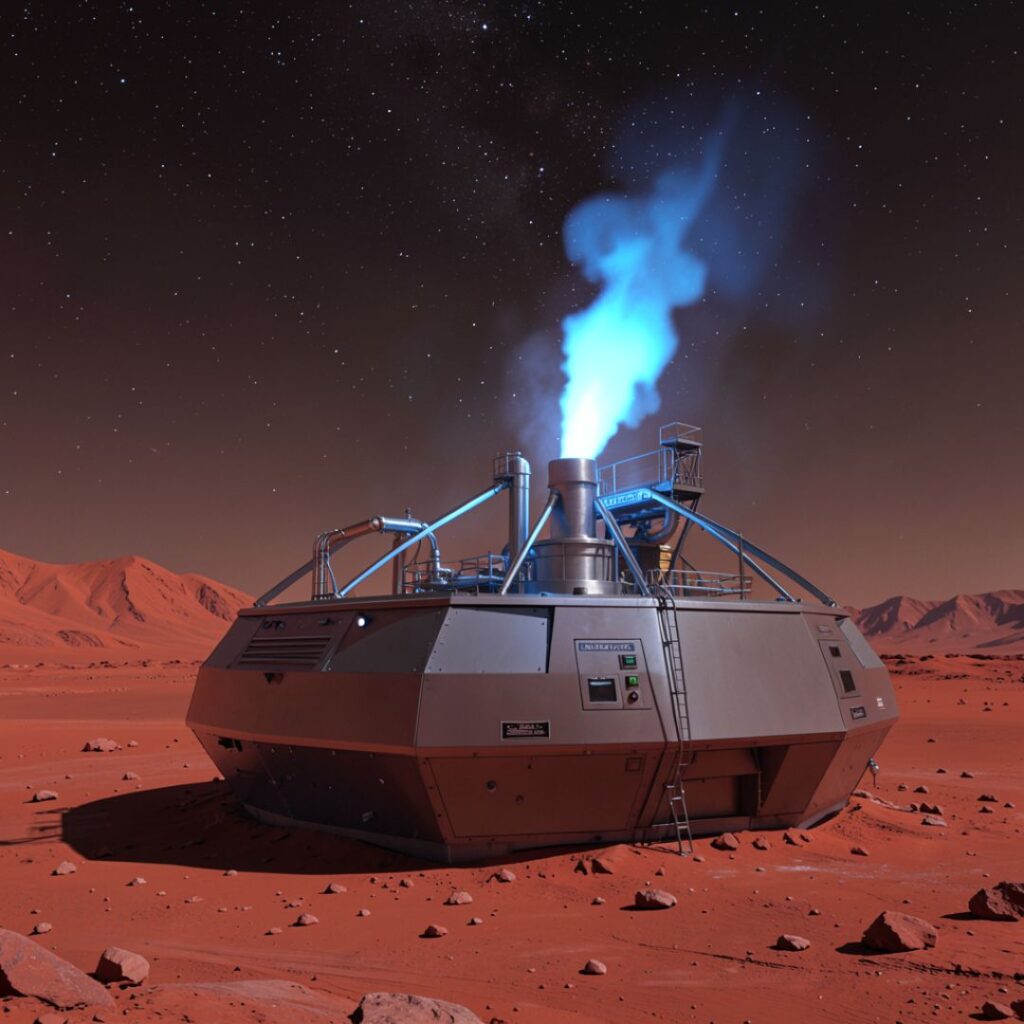
The primary barrier to Mars exploration has never been the journey to the planet; it has been the journey back. Carrying enough fuel for a return trip requires a rocket so large it becomes physically and financially impossible to launch from Earth. The solution, perfected in 2026, is In-Situ Resource Utilization (ISRU) via the optimized Sabatier Reaction.
The Chemistry of the Red Planet:
The Martian atmosphere is 95% $CO_2$. By bringing a small amount of Hydrogen ($H_2$) from Earth (or extracting it from Martian ice), we can initiate the Sabatier process: $CO_2 + 4H_2 \rightarrow CH_4 + 2H_2O$. This reaction, facilitated by advanced nickel-ruthenium catalysts, produces high-purity methane ($CH_4$)—the primary fuel for next-generation rocket engines like the SpaceX Raptor.
Solving the “Mass-to-Orbit” Crisis:
By producing fuel on the Martian surface, we reduce the initial launch mass from Earth by over 70%. This is the “Rocket Equation” hack that makes colonization feasible. The 2026 iterations of these reactors are modular and autonomous, designed to land years before humans arrive to “fill the tanks” in advance.
Life Support and Secondary Cycles:
The byproduct of the Sabatier reaction is water ($H_2O$). Through Electrolysis, this water is split back into Hydrogen (to be reused in the reactor) and Oxygen ($O_2$) for the crew to breathe. This creates a nearly closed-loop life support system. Furthermore, the heat generated by the exothermic reaction is harvested to provide thermal regulation for the habitat during the frigid Martian nights, where temperatures drop to -60°C.
The 2026 Mission Outlook:
With the successful testing of the ISRU Pilot Plant, the window for the first manned Mars mission is now wide open. We are no longer “visitors” bringing our own air and fuel; we are becoming a species capable of converting the chemistry of another world into the foundations of a new civilization.