The global race for Quantum Supremacy has hit a wall known as Decoherence. In standard quantum computers, qubits are extremely fragile; the slightest vibration or change in temperature causes the quantum state to collapse, leading to catastrophic data errors. To combat this, 2026 has seen a pivot toward Topological Quantum Computing, a method that doesn’t just manage noise—it bypasses it entirely.
The Majorana Breakthrough: At the heart of this revolution is the Majorana quasi-particle. Unlike electrons or protons, these particles act as their own anti-particles and exist only in highly specialized superconducting materials. By manipulating these particles, physicists can store information in their relative positions or “braids” in spacetime.
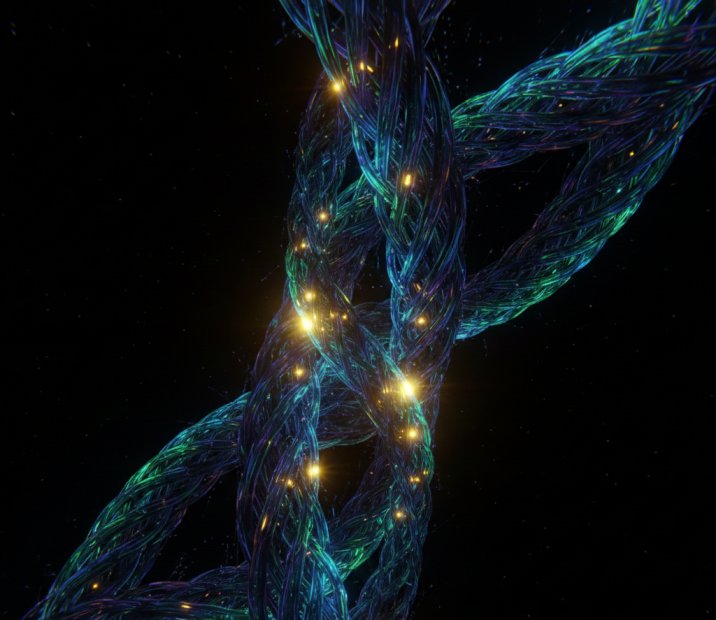
Why “Braiding” is the Ultimate Shield: Think of a standard qubit like a coin balanced on its edge—any breeze will knock it over. A topological qubit, however, is like a knot tied in a string. You can shake the string, heat it up, or move it around, but the “knot” (the data) remains. Because the information is stored globally in the structure of the braid rather than locally in a single particle, local perturbations cannot “flip” the bit. This provides a level of Fault-Tolerance that was previously thought to be decades away.
The Shift from NISQ to Scalability: We are currently in the NISQ (Noisy Intermediate-Scale Quantum) era, where we spend more processing power on “Error Correction” than on actual calculations. Topological qubits change the math. By reducing the overhead required for error correction, we can build smaller, more powerful processors. In 2026, this means quantum arrays that can finally handle Shor’s Algorithm or complex Molecular Simulations for drug discovery without crashing.
Industry Impact:
- Logistics: Solving the “Traveling Salesman” problem for global shipping in seconds.
- Cryptography: The shift toward “Post-Quantum Cryptography” becomes urgent as stable qubits threaten current RSA encryption.
- Material Science: Simulating new room-temperature superconductors using quantum-accurate models.