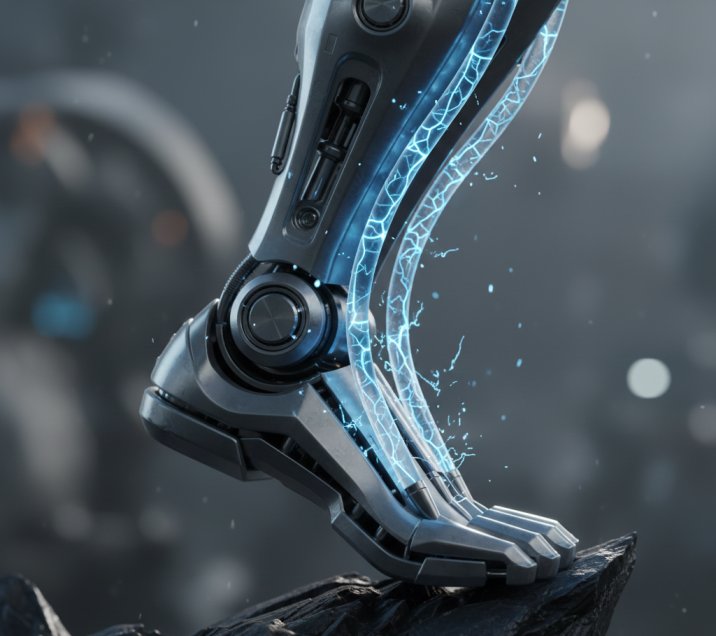
For years, humanoid robots have been “visually dominant.” To step over a curb or balance on a rock, they had to “see” the obstacle and process the image through a central AI. This created a lag that made them clumsy in real-world environments. In 2026, the breakthrough in Proprioceptive Neural Networks has given robots what humans have: a subconscious “sense” of their own body in space.
The Neural-Actuator Coupling: By embedding high-frequency strain gauges and inertial measurement units (IMUs) directly into synthetic “tendons,” engineers have created a decentralized nervous system. Instead of waiting for the “brain” to process a visual feed, the robot’s limbs react to pressure and gravity in real-time. This is known as Local-Loop Processing. If a robot slips on a patch of oil, its ankle joint adjusts in sub-milliseconds—faster than a human reflex.
Kinematic Efficiency and Gait Dynamics: This shift has profound implications for battery life and mobility. When a robot is “aware” of its own Center of Mass (CoM) through proprioception rather than calculation, it can move with greater fluid dynamic efficiency. We are seeing Gait Dynamics that mimic biological organisms, allowing robots to traverse rubble, sand, and stairs with 40% less energy consumption than 2024 models.
The “Soft Robotics” Integration: Proprioception is also the key to Tactile Sensitivity. 2026 models are equipped with “Electronic Skin” that senses Shear Stress and Thermal Conductivity. A robot can now pick up a ripe strawberry or a heavy steel beam with the same hand, adjusting its “grip force” based on the tactile feedback it receives from its fingertips. This makes robots viable for delicate tasks in surgical theaters or food processing plants.
What This Means for the Workforce: We are moving away from robots that stay in cages. Proprioceptive intelligence allows for Collaborative Robots (Cobots) that can work safely alongside humans in dynamic environments like construction sites or hospitals, where they can “feel” a human nearby and adjust their motion to avoid impact.