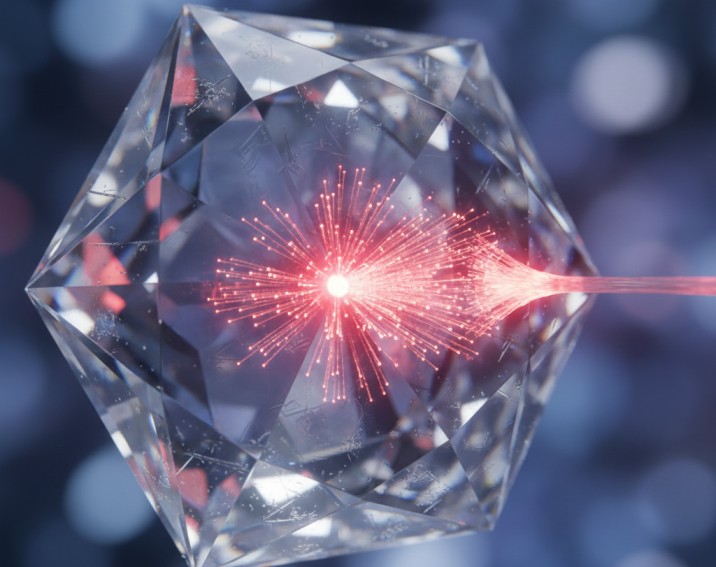
The primary bottleneck for the Quantum Internet has long been the requirement for near-absolute zero temperatures. While superconducting qubits excel in isolated laboratory environments, they fail as a medium for long-range communication. In 2026, the breakthrough lies in Silicon Carbide (SiC) photonics.
By utilizing “color centers”—point defects in the SiC crystal lattice—physicists have found a way to trap single electrons and manipulate their spin states at near-ambient temperatures. This is not just a marginal improvement; it is a fundamental shift in Quantum Interconnectivity.
The Mechanics of the SiC Spin-Photon Interface: These color centers act as natural “quantum memory” nodes. When a photon hits the defect, it becomes entangled with the electron’s spin. Because SiC is a wide-bandgap semiconductor, it is transparent to the specific wavelengths used in existing global fiber-optic networks. This means we can “overlay” quantum data onto the world’s current internet infrastructure without rebuilding the grid.
Overcoming the Decoherence Barrier: In traditional systems, the “noise” of heat destroys quantum states instantly. However, the rigid structure of the SiC lattice provides a “mechanical shield” for the trapped electron. By applying Dynamical Decoupling (a series of high-speed microwave pulses), researchers have extended the coherence time from microseconds to full seconds—enough time to route a quantum signal across a continent.
Why this matters for 2026:
- Unhackable Infrastructure: Quantum Key Distribution (QKD) can now move out of the lab and into the financial sector.
- Distributed Quantum Computing: Instead of one giant computer, we can link 1,000 small processors into a “Global Quantum Cloud.”